


Post Preview
The Evolution of Shared Memory Pools and Disaggregation
The traditional server architecture, with its tightly coupled CPU and dedicated memory, has served us well for decades. However, as computational demands escalate, particularly with the advent of AI and big data, this model increasingly presents limitations. The concept of memory pooling and sharing has emerged as a critical evolution, driven by the need for greater flexibility, efficiency, and scalability in data centers.
At its core, memory pooling involves aggregating memory resources from multiple physical servers into a single, large pool. This pooled memory can then be dynamically allocated and de-allocated to various processors or applications as needed. This approach directly addresses the problem of stranded memory, where significant portions of a server’s installed RAM sit idle because the server’s CPU doesn’t require it, or other servers are starved for memory. By allowing system integrators to dynamically allocate memory from this pool, we can significantly reduce costs and increase memory utilization.
Memory sharing, while related, often refers to multiple hosts or processes accessing the same physical memory block simultaneously. This provides not only improved memory utilization but also an added benefit of data flow efficiency, as multiple hosts can access the identical data without costly duplication. The evolution of interconnect technologies, particularly the Compute Express Link (CXL) fabric, has been instrumental in making these concepts a practical reality. CXL offers a high-speed, low-latency pathway for processors, memory devices, and accelerators to communicate efficiently, paving the way for truly dynamic provisioning of memory resources. In the future, we anticipate CXL memory existing in dedicated memory boxes on the CXL fabric, allowing systems to request and release memory from this central pool as needed.
To better understand the shift, let’s consider the fundamental differences between dedicated and pooled memory:
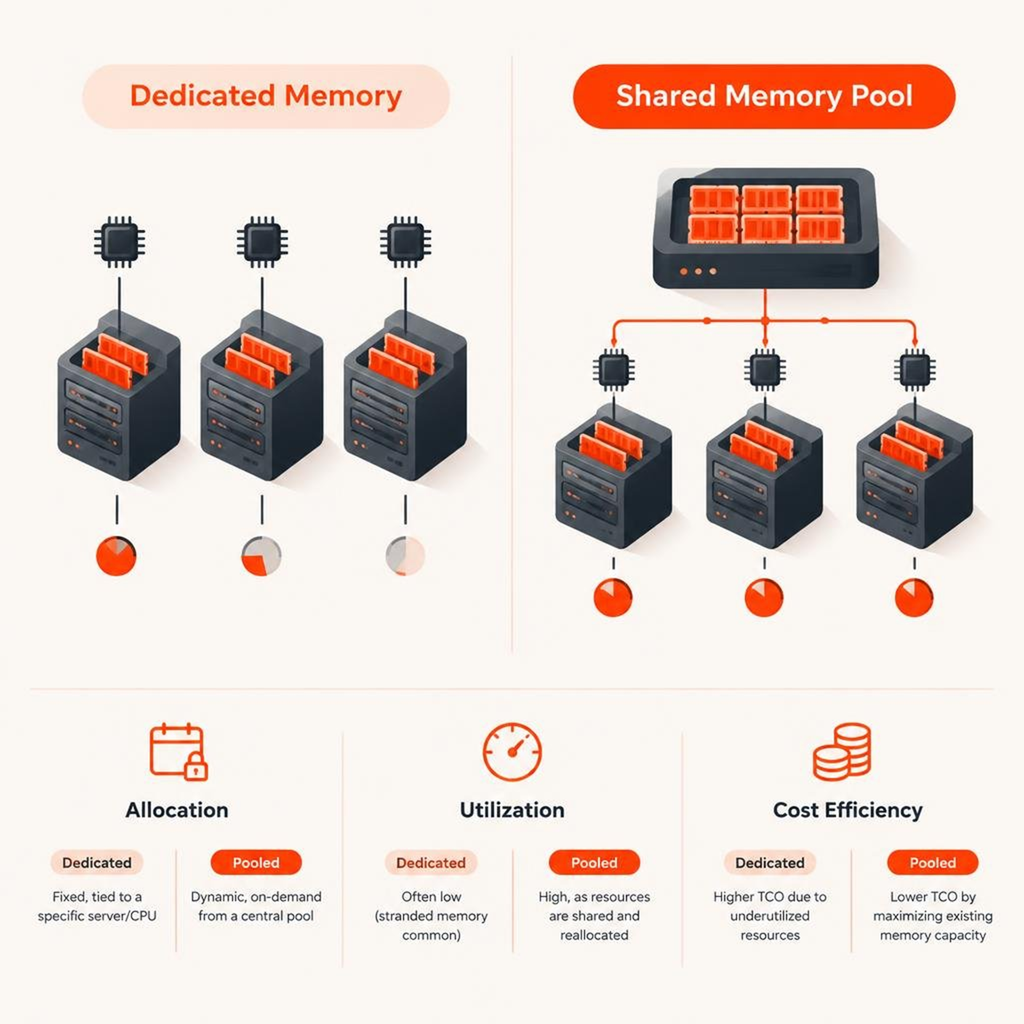
Feature Dedicated Memory Pooled Memory Allocation Fixed, tied to a specific server/CPU Dynamic, on-demand from a central pool Utilization Often low (stranded memory common) High, as resources are shared and reallocated Cost Efficiency Higher TCO due to underutilized resources Lower TCO by maximizing existing memory capacity Flexibility Low, difficult to reassign unused memory High, memory can be provisioned and de-provisioned Scalability Requires adding more servers with dedicated memory Scales by adding more memory to the pool, independent of compute Isolation Strong, each server has its own memory Can be configured for isolation or sharing, depending on need Core Differences Between Pooled and Shared Memory Architecture
While often used interchangeably, “pooled memory” and “shared memory” describe distinct architectural approaches, each with unique benefits and use cases. Understanding these differences is crucial for designing efficient modern computing environments.
Pooled Memory focuses on resource aggregation and dynamic allocation. In a pooled memory architecture, a specific memory controller manages a larger pool of memory that can be dynamically allocated and de-allocated to various processors. The key characteristic here is memory isolation between processors. Each processor, when allocated memory from the pool, typically operates within its own dedicated segment of that pool, separate from the memory pools of other processors. This provides a clear boundary, ensuring that one processor’s memory operations do not inadvertently affect another’s. The primary benefits revolve around efficient memory allocation, guaranteed memory access for assigned tasks, and improved system security through isolation.
Shared Memory, on the other hand, is fundamentally about enabling multiple entities (processors, processes, or even hosts) to access the same block of memory concurrently. This allows for extremely efficient communication between processors in a system or data center by letting them read from and write to a common region of memory. Shared memory is widely recognized as the fastest interprocess communication (IPC) mechanism because it avoids the overhead of data copying, serialization, and deserialization inherent in other communication methods like sockets or message queues. This direct access significantly improves data flow efficiency. However, this direct, multi-host access necessitates robust mechanisms for data coherency to prevent conflicts and ensure data integrity. Processes must typically synchronize their access to a shared memory object, often using primitives like POSIX semaphores, to manage read/write operations safely.
Here’s a breakdown of their distinctions:
- Memory Controllers & Management: Pooled memory is often managed by a central memory controller that handles dynamic allocation. Shared memory, while also managed, emphasizes direct access to the same physical blocks, often relying on hardware-level cache coherency protocols and software synchronization.
- Data Coherency: In shared memory, ensuring data coherency is a critical challenge. When multiple processors modify the same data, mechanisms like cache coherency protocols (often hardware-managed) and software-based locking (e.g., mutexes, semaphores) are essential to prevent stale data or race conditions. Pooled memory, by providing isolation, simplifies coherency management within each allocated segment, though coherency might still be a concern if data is explicitly moved between pooled segments.
- Multi-Host Access: Shared memory inherently supports multiple hosts accessing the same data, making it ideal for scenarios where data needs to be consumed or produced by several compute units simultaneously. Pooled memory’s strength is in providing flexible capacity to individual hosts, which may then internally share that capacity.
- IPC Performance: Shared memory is unparalleled in IPC performance due to its zero-copy nature. Pooled memory improves overall system efficiency by optimizing memory utilization, but the IPC performance benefits are indirect, stemming from reduced memory contention and more efficient resource allocation.
- Hardware Isolation: Pooled memory inherently provides a degree of hardware isolation by segmenting memory resources. While shared memory allows direct access, the underlying hardware must manage access permissions and coherency, which can be complex.
How Software-Defined Memory Solves Stranded Capacity
The issue of stranded capacity is a significant drag on data center efficiency. It refers to memory resources that are physically present but logically inaccessible or underutilized by active workloads. This leads to unnecessary capital expenditure on hardware and higher operational costs due to inefficient resource usage. Software-defined memory (SDM) directly tackles this challenge by decoupling memory from compute, enabling a dynamic, on-demand allocation model.
By implementing SDM, organizations can significantly reduce their Total Cost of Ownership (TCO). Instead of provisioning servers with peak memory requirements that are rarely met, memory can be provisioned exactly when and where it’s needed. This dynamic provisioning means memory pooling allows system integrators to allocate memory from a central pool, which reduces costs by minimizing stranded memory and increasing overall memory utilization.
Key to SDM’s effectiveness is its ability to facilitate dynamic deallocation. When an application no longer requires a certain amount of memory, those resources are released back into the central pool, becoming immediately available for other workloads. This contrasts sharply with traditional architectures where memory remains tied to a server even if it’s idle. This flexibility is a cornerstone of composable infrastructure, where compute, memory, and storage resources can be independently scaled and orchestrated to meet fluctuating demands.
This approach is revolutionizing data centers by enabling memory resources to be treated as a fluid, fungible asset. Companies are leveraging advanced software-defined memory solutions to build highly agile and cost-effective infrastructures that can adapt swiftly to evolving workload requirements. This not only optimizes resource utilization but also extends the lifespan of existing hardware investments.
Architectural Pillars of Software-Defined Memory
The realization of software-defined memory (SDM) is not merely a software abstraction; it relies heavily on foundational architectural shifts and advanced hardware capabilities. These pillars enable the dynamic pooling, sharing, and orchestration of memory resources across a data center.
Interconnect Technologies and Hardware Coherency
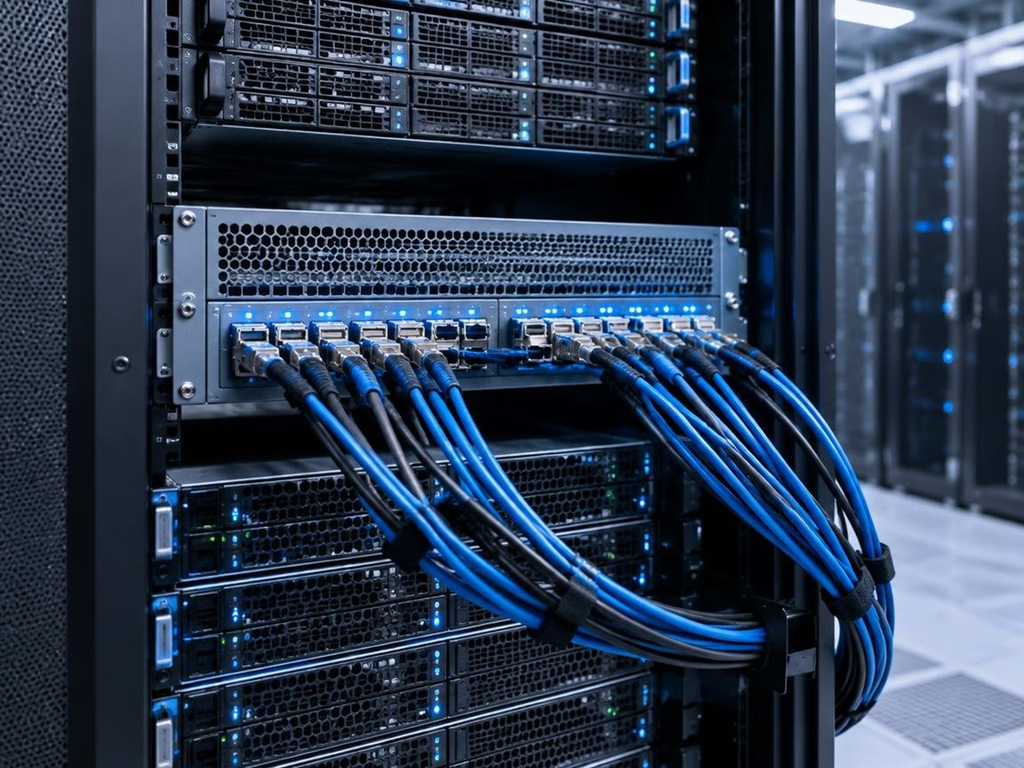
The backbone of modern SDM is a high-speed, low-latency interconnect fabric that can efficiently link CPUs, memory devices, and accelerators. Compute Express Link (CXL) stands out as a transformative technology in this regard. CXL is a next-generation interconnect built on the PCIe physical and electrical interface, but with added protocols that allow for cache-coherent memory access.
The CXL.mem protocol is particularly significant. It enables a CPU to directly access memory attached to another device (like a CXL memory expansion module or another CPU’s local memory) with cache coherency. This means that data can be shared and modified across different devices without the need for complex software-managed coherency protocols, which would introduce significant latency and overhead. CXL ensures that all copies of a data block across different caches and memory locations are consistent, a critical requirement for multi-processor and multi-accelerator environments.
Traditional Non-Uniform Memory Access (NUMA) topologies, where memory access times vary depending on the memory’s proximity to a CPU, are still prevalent. While CXL doesn’t eliminate NUMA, it significantly flattens the memory hierarchy by providing coherent access to disaggregated memory. This reduces the latency overhead associated with accessing remote memory, making pooled and shared memory practical for a wider range of applications. By allowing more CXL links and less memory per link, administrators can maximize total added memory bandwidth, while large CXL memory chunks (64GB or more) are beneficial when the primary need is increased capacity.
Operating System and Kernel-Level Integration
For software-defined memory to be truly effective, operating systems and underlying kernels must be deeply integrated to manage these dynamic memory resources. This involves extending existing memory management units and introducing new mechanisms to handle disaggregated and pooled memory.
On Linux systems, concepts like POSIX shared memory (shm_open, mmap, shm_unlink) have long provided mechanisms for processes to share regions of memory. These shared memory objects often reside in a tmpfs virtual filesystem, typically mounted under /dev/shm, demonstrating kernel persistence until explicitly unlinked or system shutdown. While traditional POSIX shared memory provides process-level sharing, SDM extends this to system-wide or even data-center-wide memory pools.
Kernel-level integration for SDM involves:
- Dynamic Page Allocation: The kernel must be capable of dynamically allocating and deallocating physical memory pages from the shared pool to requesting processes or virtual machines.
- Memory Domains: As seen in frameworks like Android’s Neural Networks API (NNAPI), memory domains allow for driver-managed buffers that suppress unnecessary data copying for tensors internal to a device. This concept can be extended to SDM, where specific memory regions are optimized for particular hardware or workload types.
- Memory-Mapped Files (mmap): This fundamental OS primitive allows files or devices to be mapped directly into a process’s virtual address space, enabling efficient data access. In an SDM context, this could extend to mapping remote pooled memory segments into a local process.
- Kernel Bypass: For ultra-low latency applications, some SDM implementations might leverage kernel bypass techniques, allowing applications to directly access memory hardware without incurring the overhead of kernel calls.
- Boost.Interprocess: For C++ developers, libraries like Boost.Interprocess provide a robust framework for managing shared memory and memory-mapped files, offering STL-like containers and allocators designed for interprocess communication within these segments. It simplifies the use of common IPC and synchronization mechanisms, including advanced memory allocation algorithms like segregated storage and adaptive pool node allocators.
These kernel and OS-level advancements are crucial for translating the hardware capabilities of CXL into usable, programmable memory resources that applications can leverage transparently.
Powering High-Performance Workloads and AI Infrastructure
The real impact of shared memory pools and software-defined memory becomes evident when we look at high-performance computing (HPC) and the burgeoning field of AI and machine learning. These workloads are inherently memory-intensive, often requiring vast amounts of data to be processed quickly and efficiently.

In traditional architectures, the memory capacity and bandwidth available to CPUs and accelerators (like GPUs) are often bottlenecks. Shared memory pools offer a solution by providing a flexible, scalable memory fabric that can feed these demanding workloads. This is particularly relevant for large-scale machine learning models, where model weights and intermediate activations can consume hundreds of gigabytes or even terabytes of memory.
GPU disaggregation, where GPUs are separated from their host CPUs and connected via a high-speed fabric, is another area where SDM shines. This allows GPUs to access a much larger pool of memory than what’s typically available on a single server, facilitating the training and inference of massive Large Language Models (LLMs) and other complex AI tasks.
Accelerating AI Workloads with Software-Defined Memory
AI and machine learning workloads, especially deep learning, are characterized by their insatiable demand for memory. Training large models involves processing massive datasets and managing billions of parameters, while inference requires rapid access to model weights. Shared memory pools significantly accelerate these processes:
- Tensor Parallelism and Model Weights: In distributed AI training, models are often split across multiple accelerators. Shared memory pools can store large model weights, allowing different GPUs or accelerators to access the same parameters without redundant copies. This is critical for techniques like tensor parallelism, where parts of a tensor are distributed across devices.
- AHardwareBuffer Integration: On platforms like Android, the Neural Networks API (NNAPI) leverages AHardwareBuffer objects, often passed through shared memory pools, to improve performance and power consumption for machine learning workloads. This allows for zero-copy IPC, where data is not copied between CPU and GPU memory but accessed directly, greatly reducing latency.
- Memory Domains: Within NNAPI, memory domains allow for driver-managed buffers that are mostly internal to the driver, suppressing unnecessary data copying across executions. This is ideal for sequence models’ state tensors or caching intermediate results, where data needs to persist between inference steps. Shared memory pools are still preferred for tensors requiring frequent client-side CPU access.
- Efficient Model Compilation and Execution: For large constant operands, such as the weight parameters in convolutional neural networks, shared memory pools are far more efficient than copying raw values via HIDL vectors during model compilation. Similarly, input and output data for model execution are always communicated through memory pools, ensuring high-throughput data transfer.
By providing a flexible, high-bandwidth memory substrate, software-defined memory solutions enable AI engineers to build and deploy larger, more complex models with greater efficiency and at a lower cost.
High-Throughput Network Dataplanes and Failure Diagnostics
Beyond AI, shared memory pooling is vital for high-throughput network devices, such as firewalls, routers, and load balancers. These devices handle immense volumes of traffic, requiring extremely fast packet processing and state management. Dataplane functions within these devices often rely on shared memory pools for efficient data buffering and inter-process communication.
However, the dynamic nature of these environments also introduces potential challenges, particularly memory allocation failures. When a shared memory pool runs out of available blocks or hits predefined thresholds, it can lead to performance degradation or even system outages. Metrics like Fail-Thresh (indicating a threshold for failures has been reached) and Fail-nomem (indicating out-of-memory conditions) are critical for diagnosing such issues in network devices.
Mitigating these failures often involves a combination of strategies:
- Identifying the Culprit: Troubleshooting guides often advise checking output from commands like ‘show dataplane pool statistics’ to identify which specific dataplane function or shared memory pool user (e.g., appid for application identification, ctd for Content-Driven Threat engine, proxy/ssl for decryption) is experiencing memory allocation failures.
- Traffic Management: Reducing the traffic rate being inspected by a firewall or using application overrides to exclude high-memory-usage applications from deep inspection can alleviate pressure on memory pools.
- Optimizing Inspection: Enabling DSRI (Disable Server Response Inspection) for trusted traffic, implementing minimal security profiles for trusted flows, or creating specific decryption exclusion rules can reduce the memory footprint of security functions.
- System-Level Monitoring: Continuous monitoring of memory pool statistics and setting alerts for Fail-Thresh or Fail-nomem conditions are best practices for proactive management. If issues persist despite these measures, opening a support case with the vendor is the recommended next step.
These diagnostic and mitigation strategies highlight the critical role of robust memory pooling management in maintaining the stability and performance of high-throughput network infrastructure.
Frequently Asked Questions About Memory Pooling
As we delve deeper into the capabilities of shared memory pools and software-defined memory, several common questions arise regarding their distinctions, implementation, and benefits.
What is the primary difference between memory pooling and memory sharing?
The core difference lies in their primary objective and access model. Memory pooling focuses on aggregating memory resources into a large, flexible pool from which individual compute units (processors, VMs, containers) can dynamically request and receive dedicated allocations. The emphasis is on efficient resource utilization, reducing stranded memory, and providing memory isolation for each allocated segment. While the memory comes from a shared pool, the allocated portion is typically dedicated to the requesting entity for its duration of use.
Memory sharing, conversely, refers to multiple compute units concurrently accessing and potentially modifying the same block of physical memory. Its primary benefit is enabling ultra-fast, zero-copy interprocess communication (IPC) and data flow efficiency, as data doesn’t need to be duplicated or serialized. However, this concurrent access necessitates robust synchronization mechanisms (e.g., mutexes, semaphores) and hardware-level cache coherency to maintain data integrity.
Pooling is about efficient allocation from a common reservoir, while sharing is about efficient concurrent access to a common region of data.
How does CXL technology facilitate software-defined memory architectures?
Compute Express Link (CXL) is a foundational technology for software-defined memory (SDM) because it provides the necessary high-speed, cache-coherent interconnect. CXL acts as a universal fabric that allows CPUs, memory devices, and accelerators to communicate and share memory resources with low latency and high bandwidth.
Here’s how CXL enables SDM:
- Memory Disaggregation: CXL allows memory to be physically separated from the CPU and placed into dedicated memory expansion modules or even entirely separate memory appliances. This disaggregated memory can then form a large, central pool.
- Cache Coherency: Crucially, CXL maintains cache coherency across the fabric. This means that a CPU can access memory attached to a CXL device (or another CPU’s memory) as if it were its own, without complex software protocols to ensure data consistency. This is vital for performance in shared memory environments.
- Dynamic Provisioning: Because CXL memory is disaggregated and coherently accessible, it can be dynamically allocated and de-allocated to different hosts or applications. A system can request memory from the CXL pool and release it when no longer needed, allowing the OS to reallocate it elsewhere.
- Heterogeneous Memory Tiers: CXL facilitates the integration of different memory technologies (e.g., DRAM, persistent memory) into a tiered memory hierarchy, all accessible via the same coherent fabric. This allows for optimization based on cost, performance, and capacity requirements.
By providing a coherent, low-latency, and high-bandwidth pathway, CXL transforms memory from a static, server-bound resource into a dynamic, pooled asset that can be orchestrated by software.
How do shared memory pools handle data coherency across multiple processors?
Handling data coherency is one of the most critical and complex aspects of shared memory pools, especially when multiple processors can read from and write to the same memory region. Without proper mechanisms, different processors might operate on stale data, leading to incorrect computations.
Modern systems primarily rely on a combination of hardware and software solutions:
- Hardware Cache Coherency Protocols: The most fundamental mechanism is implemented in hardware, typically through protocols like MESI (Modified, Exclusive, Shared, Invalid) or its variants. These protocols ensure that when a processor modifies a cache line (a small block of memory), all other processors’ caches containing a copy of that data are either invalidated or updated. This guarantees that all processors see a consistent view of memory. CXL extends this hardware coherency across its fabric, allowing disaggregated memory to participate in the same coherent domain.
- Memory Controllers and Fabric Management: Intelligent memory controllers and fabric managers play a role in orchestrating memory access, arbitrating requests, and ensuring that memory operations are ordered correctly.
- Software Synchronization Primitives: While hardware handles the low-level cache coherency, software is still responsible for managing higher-level data access patterns. This involves using synchronization primitives such as:
- Mutexes (Mutual Exclusion Locks): These ensure that only one processor can access a critical section of code or a specific data structure at a time, preventing race conditions.
- Semaphores: These are signaling mechanisms that can control access to a resource by multiple processes, allowing a certain number of concurrent accesses.
- Atomic Operations: These are low-level CPU instructions that guarantee an operation (e.g., incrementing a counter) completes without interruption, ensuring consistency for simple data types.
- Memory Barriers (Fences): These instruct the compiler and CPU to enforce an ordering of memory operations, preventing optimizations that might reorder reads and writes in a way that violates program logic.
By combining these hardware-driven cache coherency protocols with carefully implemented software synchronization, shared memory pools can effectively manage data consistency across multiple processors, enabling high-performance, parallel computing.
Conclusion
The journey into shared memory pools and software-defined memory reveals a transformative shift in how we conceive and manage computational resources. From mitigating the pervasive issue of stranded memory to powering the most demanding AI workloads, this evolution is fundamentally reshaping data center efficiency and capability.
We’ve explored the nuanced distinctions between pooled and shared memory, understanding that while both aim for greater resource utilization, they serve different architectural goals—one for flexible allocation and isolation, the other for high-speed, concurrent data access. The advent of technologies like CXL is not just an incremental improvement; it’s a paradigm shift, providing the coherent fabric necessary to disaggregate memory and orchestrate it as a fluid, software-defined resource.
As data centers continue to grapple with the exponential growth of data and the increasing complexity of applications, especially in AI and machine learning, the principles of shared memory pooling and software-defined memory will become increasingly central. They offer a pathway to more intelligent, adaptable, and cost-effective infrastructure, paving the way for truly composable computing and unlocking unprecedented levels of resource optimization and scalable performance. The future of computing is dynamic, and memory, liberated from its traditional constraints, is at the forefront of this revolution.
