


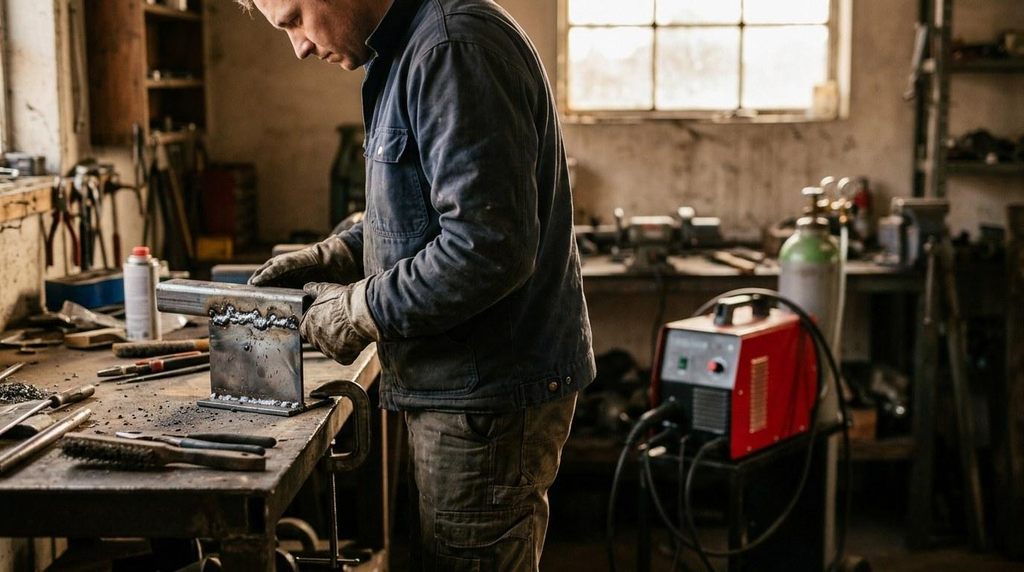
Choosing the right welding machine is a critical investment for quality results.
By a welding industry contributor. The sticker price on a new welder is often the least important number to consider. A machine that seems like a great deal can quickly become a source of frustration, wasted materials, and poor results if it doesn’t match the work you actually do. The real cost shows up in blown breakers, welds that don’t penetrate, and the realization that you need a different machine. Whether you’re a hobbyist or a professional, finding the right tool on a site like weldingsuppliesfromioc.com is non-negotiable.
For a career where the median pay is around $53,750 per year, according to the U.S. Bureau of Labor Statistics, starting with the right equipment is a foundational investment. Understanding the full landscape of options is the first step. Seeing the specifications and features laid out across different categories on a comprehensive store like that one can help you build a mental map of what’s available, from entry-level MIG units to advanced multi-process machines. The goal isn’t to find the cheapest box, but the right one for your power supply, materials, and project goals.
Quick answer: The best welder isn’t the one with the highest amperage or the lowest price. It’s the machine that correctly matches your available electrical service, the type and thickness of metal you work with most, and the welding process (MIG, TIG, or Stick) best suited for your applications.
What’s inside
- What’s the real difference between MIG, TIG, and Stick?
- How do I match a welder to my home or shop’s power?
- What does “duty cycle” actually mean for my projects?
- Frequently Asked Questions
- Choosing Your Welder: From Spec Sheet to Shop Floor
What’s the real difference between MIG, TIG, and Stick?
The core difference is how each process melts metal and shields the molten weld pool from oxygen, which directly impacts speed, precision, and the types of materials you can join.
MIG (Gas Metal Arc Welding) is often the easiest process to learn. It uses a spool of wire that is fed continuously through a gun at a pre-selected speed. A shielding gas, typically a mix of argon and carbon dioxide, flows from the gun to protect the weld. This setup makes it fast and efficient for production work, especially on mild steel in a shop environment.
TIG (Gas Tungsten Arc Welding) offers the most control and produces the cleanest welds. It uses a non-consumable tungsten electrode to create the arc, and you feed a separate filler rod into the weld pool with your other hand. This two-handed process is slower but essential for high-quality work on sensitive metals like aluminum, stainless steel, and titanium. It requires more skill but delivers superior results.
Stick welding (Shielded Metal Arc Welding) is the most rugged and versatile of the three. It uses a consumable electrode, or “stick,” coated in a material called flux. As the stick burns, the flux vaporizes to create its own shielding gas. This makes it ideal for working outdoors in windy conditions or on metal that isn’t perfectly clean. It’s a go-to process for heavy equipment repair and structural steel.
❝ A good way to frame the choice is by the job’s primary constraint. If the priority is speed on clean steel, choose MIG. If it’s absolute precision on any metal, choose TIG. If the work is outdoors on thick or dirty material, choose Stick.
Choosing a process that fights your project’s needs leads to wasted time and materials. For a professional welder, whose median pay is $25.84 per hour according to the U.S. Bureau of Labor Statistics, inefficiency directly cuts into earnings. While the overall employment for welders is projected to grow a modest 2% through 2035, specialization in a high-skill process like TIG can create opportunities in more demanding, higher-paying sectors. Your first machine isn’t just a tool; it’s an investment in a specific type of work.
How do I match a welder to my home or shop’s power?
You match a welder by checking its required input voltage (120V or 240V) and amperage draw against the specific circuit breakers and outlets available in your workspace.
This is the single most common mistake for new buyers. A powerful welder is useless if you can’t supply it with enough electricity. Most homes are wired with standard 120V outlets on 15 or 20-amp circuits. These can power smaller MIG and Stick welders, but only for welding thinner materials, typically up to 3/16-inch steel. Trying to push a 120V machine too hard will repeatedly trip the breaker.
For welding thicker materials, a 240V power source is necessary. These are the larger outlets used for electric dryers or ranges, often connected to breakers rated for 30 to 50 amps. A machine running on 240V can achieve its full power output, allowing you to weld 3/8-inch steel in a single pass and thicker plate with multiple passes. Ensuring your wiring and circuit protection are correctly sized is a critical safety step, as outlined by the Occupational Safety and Health Administration’s standards for arc welding equipment installation. An undersized circuit is a significant fire hazard.
| Feature | 120V Input Power | 240V Input Power |
| Common Outlet | Standard household (NEMA 5-15) | Dedicated welder outlet (NEMA 6-50) |
| Typical Breaker | 15 to 20 Amps | 30 to 50 Amps |
| Max Steel Thickness | Approx. 3/16 inch | 3/8 inch single pass, thicker with multiple passes |
| Best For | Light fabrication, sheet metal, hobbyist work | Heavy repair, structural work, production |
❝ Many modern machines are “dual-voltage,” meaning they can run on either 120V or 240V power. But don’t assume you get the same performance. A 200-amp welder might only be capable of 140 amps when plugged into a 120V wall outlet. Always check the machine’s specifications for its maximum output on each voltage.
Before you even look at welders, go to your breaker panel. Find the circuit for your garage or shop and read the number printed on the switch. That number is the maximum amperage the circuit can handle. That single number dictates what class of machine you can realistically run without calling an electrician.
What does “duty cycle” actually mean for my projects?
It tells you how long a machine can weld continuously within a 10-minute window before it must cool down to prevent damage. This is one of the most important, and most misunderstood, specifications on any welder.
Duty cycle is expressed as a percentage at a specific amperage. For example, a welder rated for a 30% duty cycle at 180 amps can weld for three minutes straight at that power level. Afterward, it must idle for the remaining seven minutes of that 10-minute period to cool its internal components. Trying to push past this limit will trigger a thermal overload circuit, shutting the machine off until it cools down.
This specification is not a single number. A machine’s duty cycle changes dramatically with the amperage you use. The same welder with a 30% duty cycle at 180 amps might have a 60% duty cycle at 130 amps, or even a 100% duty cycle (continuous welding) at 90 amps. The lower the power output, the less heat is generated, and the longer the machine can run. This is why it’s critical to look at the full duty cycle chart for a machine, not just the single number advertised on the box.
❝ When evaluating a welder, don’t just ask “What’s the duty cycle?” Ask, “What’s the duty cycle at the amperage I will use most often?” A hobbyist making small art pieces might never exceed a 20% duty cycle. A fabricator running long, continuous beads on 1/4-inch plate needs a machine that can handle a much higher duty cycle to maintain productivity.
The internal mechanism is all about heat management. Welding generates immense heat, not just at the arc but inside the machine’s transformer and power electronics. Inverter-based welders are lighter and more efficient, but their smaller components can be more sensitive to heat buildup. A higher duty cycle indicates the manufacturer has invested in larger heat sinks, more robust components, and better cooling fans. It’s a direct reflection of the machine’s industrial build quality and its ability to handle sustained, professional use without interruption. For a production shop, a welder that is constantly shutting down is a major bottleneck.
Frequently Asked Questions
Is a multi-process welder a smart investment or a compromise? A multi-process machine can be a great investment if you need versatility for different jobs or want to learn multiple welding types without buying three separate machines. They offer MIG, TIG, and Stick capabilities in one box. The compromise is that they may lack the advanced, specialized features of a dedicated unit, such as the high-frequency start or AC output needed for professional aluminum TIG welding.
What’s the difference between an inverter and a transformer welder? Transformer welders represent the older, heavier technology. They are simple and durable but are less energy-efficient. Inverter welders use modern electronics to convert power, making them significantly lighter, more portable, and more efficient. This technology also allows for much finer control over the welding arc, which is why almost all new feature-rich machines are inverter-based.
Do I really need a separate gas cylinder for MIG welding? Not always. You can use a process called flux-cored arc welding (FCAW), which uses a special wire with a flux agent inside it. As the wire melts, the flux creates its own shielding gas, protecting the weld. This is ideal for working outdoors where wind would blow away shielding gas from a tank, but it typically produces more smoke and spatter than standard gas-shielded MIG welding.
What basic safety gear is non-negotiable? At an absolute minimum, you need an auto-darkening welding helmet, flame-resistant welding gloves, and a jacket made of leather or other flame-resistant material. The ultraviolet radiation from a welding arc can cause a painful “sunburn” on exposed skin in just a few minutes. Proper ventilation is also critical to avoid inhaling fumes, especially when welding galvanized steel or working in a confined area.
Can I weld aluminum with a basic MIG welder? It is very difficult and generally not recommended. Aluminum wire is much softer than steel wire and tends to tangle and jam inside the long liner of a standard MIG gun. To properly MIG weld aluminum, you need a special attachment called a spool gun, which mounts a small, one-pound spool of wire directly on the gun itself. For the highest quality results on aluminum, most professionals use an AC TIG welder.
Choosing Your Welder: From Spec Sheet to Shop Floor
Selecting the right welding machine is less about finding the “best” one and more about accurately matching the tool to the task. The ideal welder for you is defined by three practical constraints: the welding process your projects demand, the electrical power your shop can supply, and the duty cycle your workflow requires. Getting any of these wrong means investing in a machine that either can’t perform the job or creates a constant bottleneck.
The most common mistake is to focus on maximum amperage while ignoring the two factors that determine if you can even use it: input power and duty cycle. A powerful, feature-rich machine is wasted if it constantly trips your breakers or shuts down to cool off mid-project. The numbers on the spec sheet represent a machine’s potential under ideal conditions. The reality of your work is dictated by the outlet on your wall and the length of the welds you need to make.
Before you get lost in brand comparisons, start by defining your own environment. Identify the most common material and thickness you plan to weld. Then, walk to your breaker panel and confirm the circuit’s amperage. These two facts will narrow your choices more effectively than anything else. They shift the decision from a confusing menu of options to a logical process of elimination, ensuring the machine you buy is the one you can actually use.
About the author
Welding Supplies from IOC is an authorized online distributor of welding equipment, safety gear, and consumables from manufacturers including Miller, Lincoln, and ESAB. The company provides a platform for professionals, hobbyists, and beginners to compare technical specifications across a wide range of machines and supplies. They focus on helping users match the right tools to their specific applications, from small-scale fabrication to heavy industrial work, by offering detailed product information and categorizing equipment by skill level.
