


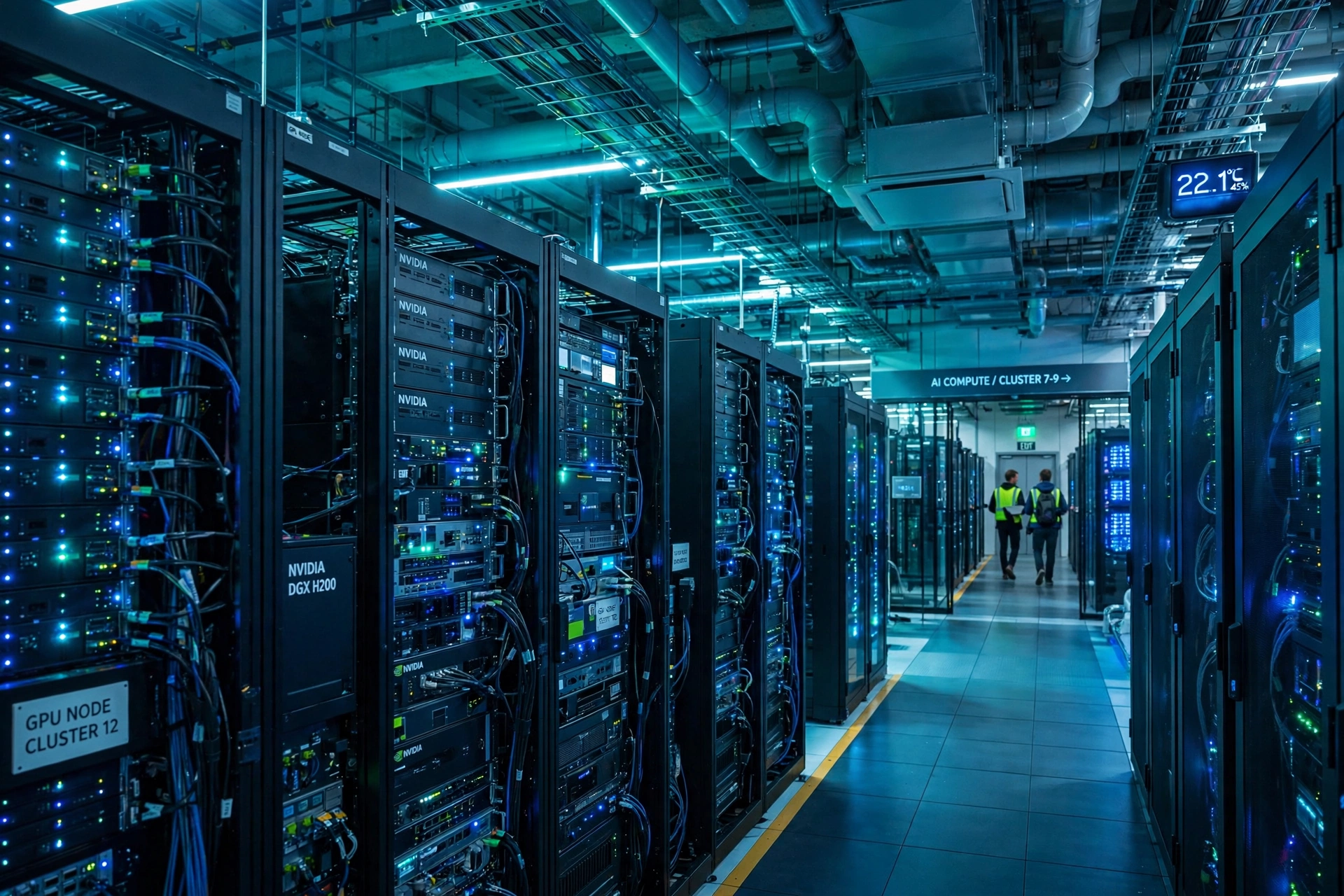
The artificial intelligence boom has produced eye-watering numbers before, but a fresh wave of analysis this week asks an uncomfortable question: what happens when the cost of building AI infrastructure grows faster than the revenue the technology can realistically generate? Reporting highlighted by The Register suggests infrastructure spending forecasts are now outstripping expected AI revenue, while a separate analysis arguing that paying for AI’s data centers would take 250 million jobs — more than the entire American workforce of about 159 million — has gone viral in technology circles. The figures are deliberately provocative, but the underlying tension is real.
Why data centers cost so much more than expected
A modern AI data center is not simply a warehouse full of computers. Each facility needs vast amounts of reliable electricity, industrial cooling, high-speed networking and, above all, graphics processors that remain among the most expensive pieces of hardware in the world. A single advanced accelerator can cost as much as a luxury car, and a large training cluster needs tens of thousands of them, all replaced on a cycle of just a few years as newer chips arrive.
On top of the hardware sits the energy bill. Training and running large models consumes power continuously, and utilities in several regions are already warning that new data center connections are straining local grids. Companies are signing long-term power contracts, funding new generation and in some cases restarting dormant plants — costs that never appear in a simple comparison of chip prices, but which determine whether a facility ever turns a profit. Businesses weighing their own spending can see a smaller version of the same problem in our breakdown of what AI content tools actually cost a small business.
The revenue side of the equation
None of this would matter if revenue were keeping pace. AI subscriptions, cloud services and enterprise contracts are growing quickly, and the largest technology firms report strong demand. The concern raised by analysts is about the gap between the two curves: capital expenditure is being committed years in advance, on the assumption that future demand will be many times larger than today’s, while the revenue that can be confidently forecast covers only part of that commitment.
There is also a timing problem. Data centers are typically financed over long periods, but the chips inside them lose value quickly. If a facility is still paying off hardware that competitors have already replaced with faster, cheaper generations, its economics deteriorate even while demand for AI services in general keeps rising. That is why sceptics describe some current projects as a bet not merely on AI succeeding, but on it succeeding at a very specific speed.
What the 250 million jobs figure really means
The claim that paying for AI’s data centers would require the output of 250 million jobs is not a prediction that those jobs will exist or disappear. It is a way of translating an abstract capital figure into human scale: the planned spending is so large that, expressed as wages, it exceeds what the entire United States workforce earns. Critics of the framing argue that infrastructure has always looked expensive before demand caught up — railways, broadband and cloud computing all attracted similar warnings — and that falling costs per calculation will eventually close the gap.
Supporters of continued investment make a related point about security and resilience. As our coverage of AI in cybersecurity shows, capability is not only a commercial question; governments increasingly treat advanced computing capacity as strategic infrastructure, which changes how willing investors are to fund it through periods of weak returns.
What to watch next
The next twelve months will provide harder evidence than any forecast. Watch for three signals: whether cloud providers begin delaying or quietly cancelling announced facilities, whether the price of renting AI computing power keeps falling faster than the cost of providing it, and whether enterprise customers renew their AI contracts at the same scale after initial experiments. If rental prices stabilise while usage keeps climbing, the optimists will claim vindication. If utilisation disappoints, the phrase “the AI math isn’t mathing” may move from a headline to an earnings-call reality.
For readers, the sensible conclusion sits between hype and panic. AI infrastructure spending is genuinely enormous and genuinely risky, and some projects will lose money. But the same was true of every previous computing wave — the winners were rarely the companies that spent the most, and almost always the ones that matched spending to real, paying demand.

1 Comment
Pingback: AI Data Center Spending Is Outpacing Revenue — and the Math Is Getting Uncomfortable - TechWrote