


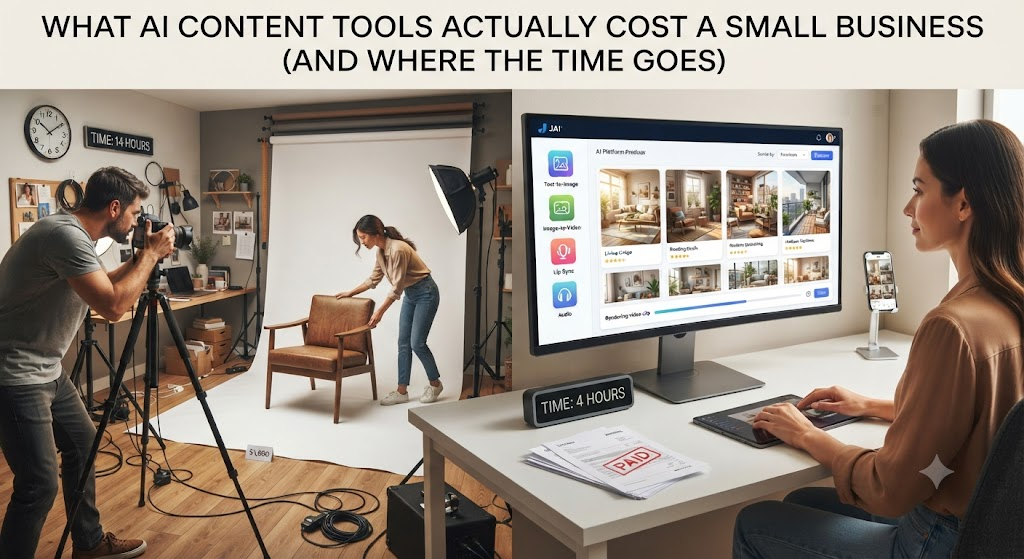
A three-person furniture shop in Portland needed 40 product shots for a new catalog. The old way meant a studio rental, a photographer, a half-day of styling, and roughly $1,800 before anyone touched a single image. Instead, the owner shot each piece on a phone against a plain wall, then generated clean white-background versions and three lifestyle scenes per product using AI. Total spend that week? Under $60 in credits and about four hours of her own time. The catalog shipped on a Tuesday.
Stories like that are getting common. Not because AI makes everything perfect, but because the math changed. For a lot of marketing teams and e-commerce sellers, the question stopped being “is this good enough?” and became “why are we still paying agency rates for assets we burn through in a week?”
The work that used to sit in a queue
Most content bottlenecks aren’t creative. They’re logistical. A social manager waits on a designer. The designer waits on stock photo approvals. A product launch slips because the video editor is booked for ten days. AI tools attack that backlog directly, and the breadth is what surprises people the first time.
Take text-to-image. An agency running paid social for a supplement brand needs a dozen ad concepts before Friday. Models like Flux or Stable Diffusion can spin up variations in minutes, and the team A/B tests visual angles they’d never have budgeted to shoot. Some win. Most don’t. That’s fine when each test costs cents instead of a photo shoot.
Then there’s image-to-video, which has quietly become the workhorse. You feed it a static product photo and get a five-second clip of the bottle rotating, the fabric catching light, the watch hand sweeping. For Reels and TikTok, where motion in the first second decides whether someone scrolls past, that single capability has replaced whole freelance gigs. A Shopify seller I spoke with runs every new SKU photo through image-to-video before it ever hits the store. Costs about a dollar a clip.
Lip sync and spokesperson video are where it gets a little uncanny, in a useful way. Small SaaS companies that can’t afford an on-camera presenter generate a talking avatar, feed it a script, and ship an explainer in an afternoon. Is it as warm as a real founder on camera? No. But for a feature announcement or a help-center walkthrough, it clears the bar and frees the founder to do literally anything else.
Face swaps, character swaps, and the boring-but-valuable stuff
Face swap and character swap get talked about like party tricks. In practice they solve dull problems. A clothing brand reshoots a campaign for a new region and needs different models without flying anyone anywhere. A game studio swaps a character across a dozen promo frames to test which mascot reads better. An events company localizes the same ad for four markets by changing the on-screen presenter. None of that is flashy. All of it used to cost real money and real calendar time.
And it’s not only visual. AI music and audio generation now cover the licensing headache that haunts every short-form video team. Instead of paying per-track or risking a copyright strike, teams generate a royalty-free backing track that fits the mood and length they actually need. A 22-second reel gets a 22-second track. No awkward fade-outs, no licensing spreadsheet.
“We stopped thinking of these as separate tools and started treating content like a faucet you turn on,” says Dana Whitlock, founder of Brightseam, a six-person performance marketing agency in Austin. “Last quarter we made 340 ad variations for a client across image, video, and audio. Two years ago that number would’ve been maybe 30, and we’d have hated half of them. The cost per asset dropped to where testing got genuinely cheap. That’s the real shift — not the novelty, the volume.”
The case for consolidation
Here’s the catch most teams hit around month two. The tooling fragments fast. One subscription for image generation, another for video, a third for voice, a fourth for music. Each with its own login, billing cycle, and credit system you forget about until the renewal hits. A marketing lead at a mid-size DTC brand told me they were paying for five separate AI platforms and actively using maybe two. The rest were dead weight on the company card.
That’s pushing businesses toward consolidated platforms that bundle the models under one roof and one credit balance. JAI’s AI tools platform is one example of this approach it runs on pay-per-use credits rather than a monthly subscription, gives new accounts 10 free credits to test with, and covers the spread from text-to-image and image-to-video to lip sync, face swap, and audio, with commercial rights and no watermarks on the output. The pitch isn’t any single feature. It’s that a small team can do its product shots, its ad clips, and its reel soundtrack without juggling four invoices.
Pay-per-use matters more than it sounds for businesses with uneven output. A seasonal retailer might generate 500 assets in November and almost nothing in February. A flat subscription punishes that pattern. Credits that don’t expire on a monthly clock match how the work actually flows.
What this means for budgets
Run the rough numbers and the appeal is obvious. A traditional product photo shoot runs $1,000 to $3,000 a day. A short branded video from a freelancer starts around $500 and climbs. Stock music licenses pile up at $20 to $100 a track. For a brand producing content weekly, that’s tens of thousands a year before salaries.
The AI version isn’t free, and anyone who tells you it is hasn’t run a real campaign. You still need someone with taste to direct it, cull the bad outputs, and keep the brand consistent. Roughly a third of what these tools generate ends up unusable on the first pass. But the usable third costs a fraction of the old workflow, and you get it the same day. That’s the trade most teams are now making with their eyes open.
None of this replaces a great creative director or a genuinely original campaign. What it does is clear the backlog of routine assets, the catalog shots, the localized variants, the weekly reels so the human time goes toward the work that actually needs a human. For small businesses that never had a content budget to begin with, that’s the bigger story. The next year or two will sort out which platforms earn the credit-card slot and which quietly get cancelled. The teams testing widely right now are the ones who’ll know.
