


The most personal medicine imaginable — a vaccine synthesised from the mutations in one patient’s own tumour — has undergone its first clinical examination in ovarian cancer. The phase 1 trial, reported in Nature Medicine, tested NeoVax alongside nivolumab in patients with platinum-sensitive disease and concluded that the vaccine was feasible to deliver and had an acceptable safety profile.
The vocabulary of early trials is deliberately unglamorous, and that restraint should be respected. Feasibility and safety are the questions phase 1 exists to answer; efficacy belongs to later studies. Within those limits, the trial did what it set out to do.
Algorithms at the heart of the vaccine
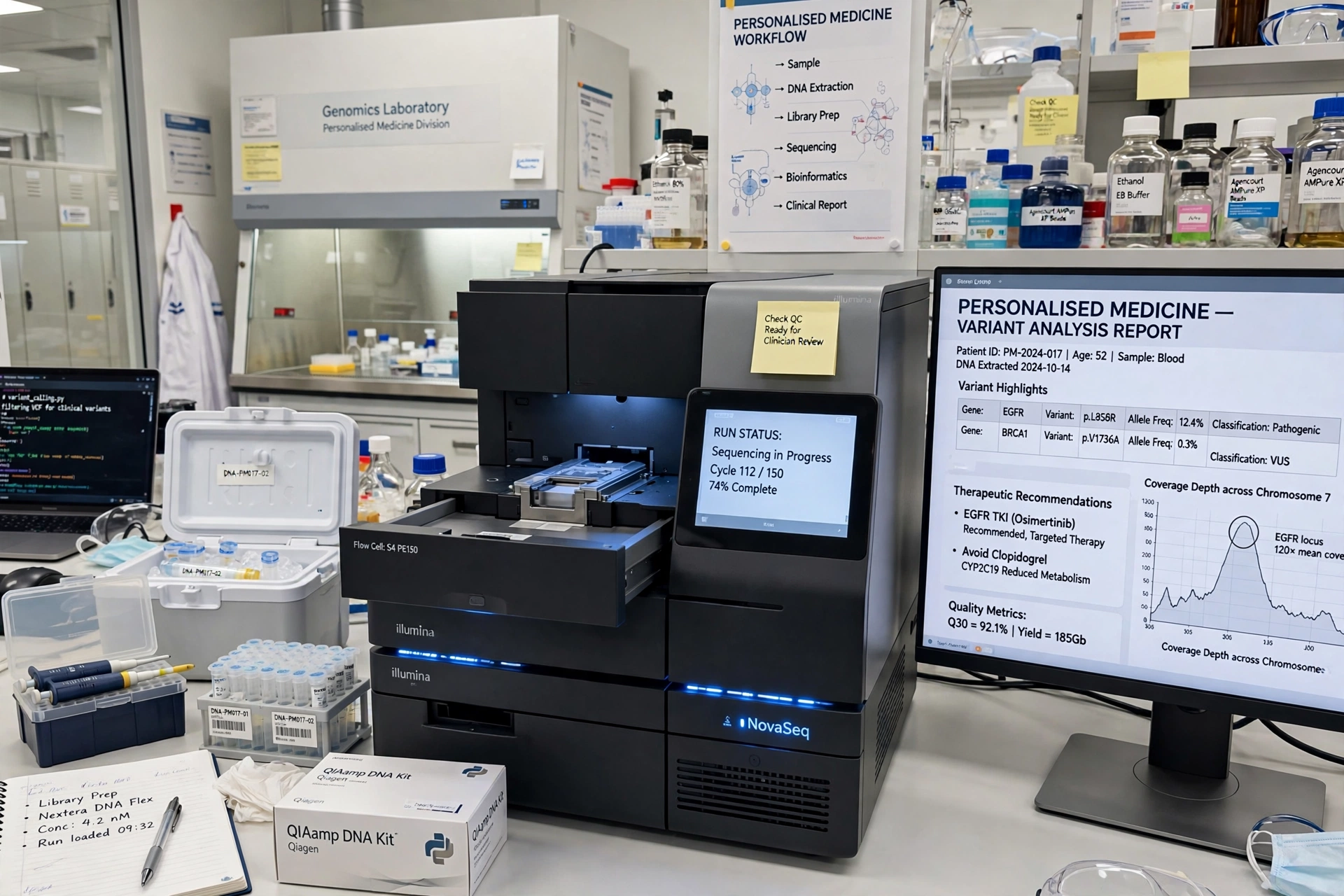
NeoVax depends on computation as heavily as on biology. After a tumour is sequenced, software compares cancer DNA with healthy DNA and predicts which mutated protein fragments — neoantigens — are most likely to be displayed on tumour cells and recognised by T cells. The top candidates form the recipe for an individual vaccine.
Nivolumab then plays the role of checkpoint release. By inhibiting PD-1, it counteracts a mechanism tumours use to deactivate immune cells. The combined concept is that vaccination provides the targets and nivolumab preserves the attack.
Why platinum-sensitive patients were chosen
Platinum-sensitive ovarian cancer identifies patients whose disease responded to platinum chemotherapy and remained controlled for a meaningful interval. Testing a vaccine in this setting makes strategic sense: tumour burden has been reduced by chemotherapy, and the clinical goal shifts to preventing or delaying the recurrence that so often follows.
Ovarian cancer has resisted immunotherapy more stubbornly than many other cancers, in part because its tumours offer the immune system few obvious flags. Neoantigens derived from the tumour’s unique mutations are, by definition, flags carried by no healthy cell — the theoretical answer to that problem.
Reading early results without hype
Technology coverage repeatedly confronts the same temptation this trial presents: to convert a promising early signal into a sweeping conclusion. Our reporting on the Microsoft AI doom loop warning for the web argued for proportion in assessing claims about complex systems, and the same proportion applies here. A safe, feasible phase 1 vaccine is a genuine milestone and simultaneously only a beginning.
Practically, patients should understand that NeoVax remains experimental, accessible through trials rather than routine care, and unproven as a means of extending life. Researchers, meanwhile, will mine this study’s immune-monitoring data for evidence that vaccinated patients generated T cells aimed at their tumours.
The manufacturing question
Every personalised therapy raises an industrial challenge: the product is redesigned for each recipient. Turning that into an affordable, timely service is an engineering and logistics problem as much as a medical one. Demonstrating feasibility in a trial setting is the first evidence that the pipeline can work; scaling it is the next.
Prediction is the product
The least visible part of NeoVax may be its most consequential: the prediction software that chooses which neoantigens enter the vaccine. A tumour can carry hundreds of mutations, but only a limited number can be included, and choosing poorly means training the immune system on targets it will never productively see. Every trial of this kind is therefore also a test of an algorithm, judged by whether the selected targets actually provoke responses in patients.
That dual nature — drug and software in one — is increasingly typical of advanced medicine, and it changes what evidence means. Improving the algorithm between studies can change the treatment itself, so researchers must document versions and selection rules as carefully as doses. If personalised vaccines succeed, their success will belong jointly to immunology and to the unglamorous discipline of prediction, refined one verified patient dataset at a time.
Taken together, the trial’s findings justify continued investment in the approach. Ovarian cancer urgently needs strategies beyond repeated chemotherapy, and a vaccine built from the disease’s own mutations has now shown it can be given safely. The harder verdict — whether it works — awaits the trials this one makes possible.
