


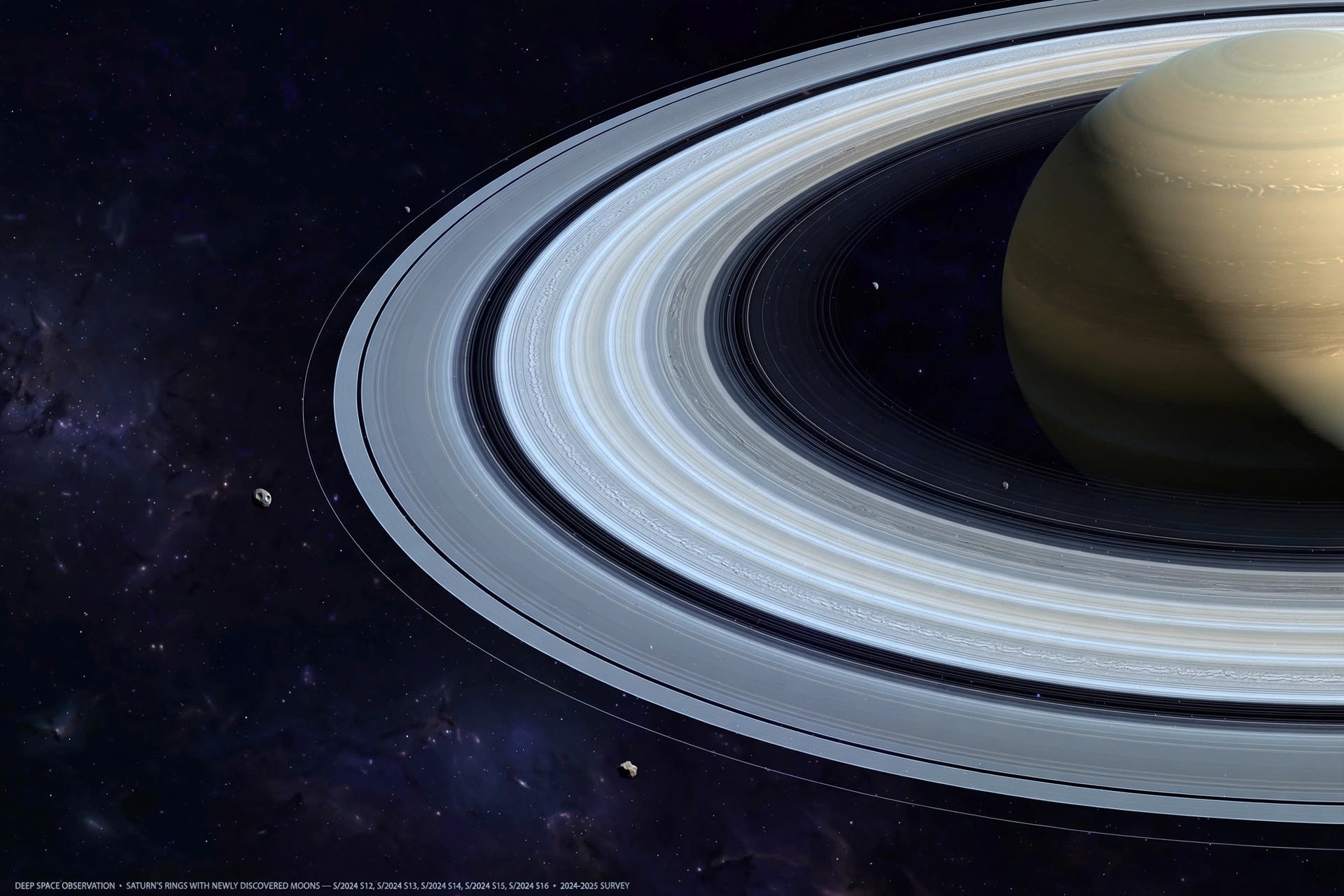
Saturn has not merely broken the record for the most moons — it has left the competition behind entirely. The confirmation of 128 new moons takes the planet’s total to 274, the largest number of natural satellites known around any world in the solar system. The haul is the product of a systematic survey conducted with the Canada-France-Hawaii Telescope and validated over years of follow-up observations.
Researchers at the University of British Columbia contributed to the effort, which illustrates how modern astronomy advances: not through a single spectacular image, but through the accumulation and careful checking of thousands of faint data points until certainty emerges.
Understanding the irregular population
The additions belong to Saturn’s irregular moons, a swarm of small bodies orbiting far from the planet in inclined, eccentric and often retrograde paths. Most measure only a few kilometres across. In size and behaviour they resemble asteroids more than the classic spherical moons, and that resemblance is informative.
The prevailing account holds that irregular moons are captured objects. Drawn in by Saturn’s gravity during the solar system’s restless youth, some survived intact while others collided and fragmented, producing the families of related debris that astronomers can still identify from shared orbital patterns today.
Software, stacking and certainty
Detecting a three-kilometre rock at Saturn’s distance pushes observation to its limits. The survey’s method — shifting and stacking many images so that objects moving with Saturn reinforce one another — depends as much on computing as on optics. Candidates must then be recovered repeatedly, across years, before the International Astronomical Union will certify an orbit and recognise a discovery.
Readers of our breakdown of the cost maths of AI data centres and infrastructure spending will appreciate the underlying principle: large, complex results are usually built from enormous numbers of individually modest inputs, properly organised. In this case the output is not a data hall but a census — 274 entries strong.
Why the census matters scientifically
A complete-as-possible inventory constrains theories of planet formation. The number of captured bodies, their sizes and their family structure all feed models of how the giant planets migrated and interacted early in the solar system’s history. Each newly resolved family is a fossil of a specific collision, offering a datable event in Saturn’s biography.
The count also recalibrates expectations for other planets. Saturn’s dominance may partly reflect how hard astronomers have looked at Saturn; equally deep searches elsewhere could yet produce surprises, though overturning a lead of this size would require a remarkable find.
The work continues
With recognition secured, attention shifts to naming the new moons — Saturn’s naming traditions draw on Norse, Inuit and Gallic mythologies — and to pushing the search threshold fainter still. If history is a guide, the number 274 is a milestone rather than a destination.
The role of data in the discovery
It is easy to credit the telescope and overlook the data pipeline, but the 128 confirmations were as much a computing achievement as an optical one. Each observing run produced images in which the moons were, individually, almost indistinguishable from noise. Extraction depended on algorithms that modelled Saturn’s motion, aligned hundreds of frames and flagged the faint points that moved exactly as a moon should — a workflow closer to large-scale data engineering than to classical stargazing.
This has a consequence astronomers are still absorbing: archives have become discovery instruments in their own right. Images taken years ago for other purposes may contain moons nobody extracted at the time, waiting for better software. The census of 274 may therefore grow not only through new observations but through re-analysis — the past, reprocessed, yielding findings its original observers never saw.
What the survey has already achieved is a change in perspective. Saturn is no longer a planet that happens to have many moons; it is a vast, structured system of hundreds of worlds, most of them discovered not by explorers but by algorithms, telescopes and patience combined.
